
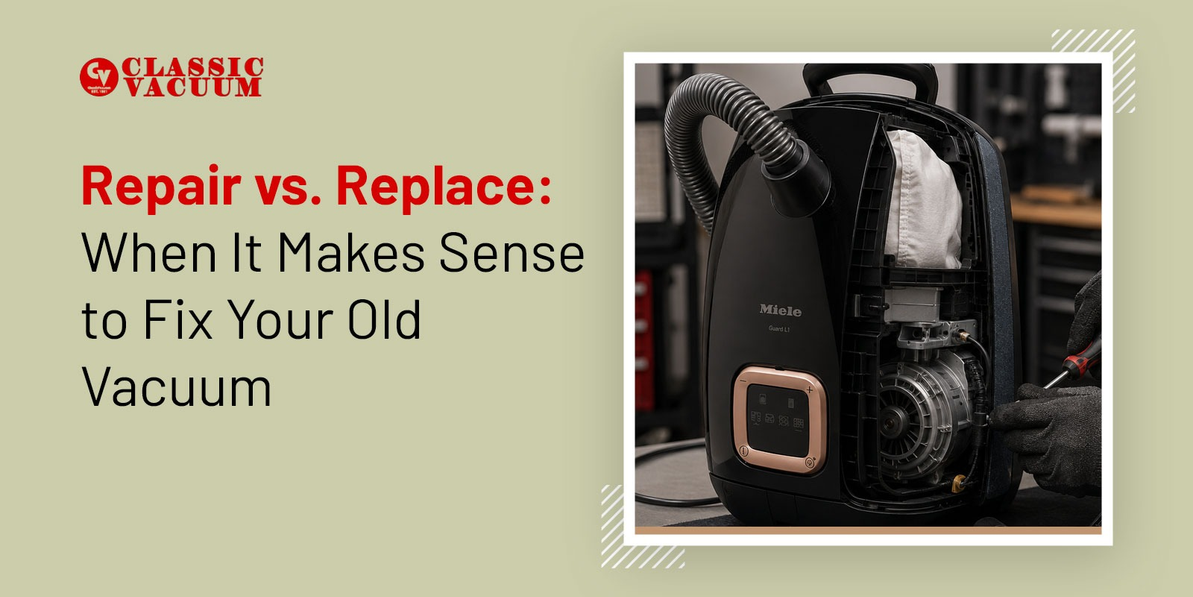
Repair vs. Replace: When It Makes Sense to Fix Your Old Vacuum
Your vacuum just died mid-cleaning. There's a pile of dust on the carpet, the dog is staring at you, and now you're standing in the kitchen Googling "is it worth repairing an old vacuum cleaner?"
You're not alone. We hear this question every single day at Classic Vacuum. And the honest answer is: it depends.
But here's what we can tell you after years of cracking open vacuums, replacing motors, swapping belts, and telling people the truth about their machines: most vacuums that end up in the trash still have life left in them. A lot of life, actually.
So before you toss your vacuum and drop three hundred bucks on a shiny new one that might not last half as long, let's walk through this together. By the end, you'll know exactly when to repair, when to replace, and how to stop wasting money on the wrong decision.
How Long Should a Vacuum Actually Last?
This is where things get interesting, because the answer varies wildly depending on what you bought.
A solid upright vacuum from a quality brand? Eight to ten years, easy. Canister vacuums tend to last even longer. Ten to fifteen years isn't unusual for something like a Miele or an Electrolux. These machines were built to be serviced. Parts are available. Motors are replaceable. They were designed by people who assumed you'd want to keep them.
Cordless stick vacuums are a different story. Three to six years is a realistic lifespan. The battery is usually the first thing to go, and once it does, you're looking at a replacement cost that's sometimes half the price of the vacuum itself. Robot vacuums sit in the same range, with three to five years before sensors fail, batteries degrade, or the brushes just can't keep up anymore.
According to Consumer Reports, regular maintenance is the single biggest factor in how long your vacuum lasts. That means cleaning the filters, checking the belt, and clearing blockages. These are stuff most people never do until something breaks.
Here's the takeaway: if you bought a well-made vacuum and took reasonable care of it, there's a good chance it's worth fixing. If you bought a budget model four years ago and never changed the filter once, replacing it might make more sense.
The Cheap Fixes Most People Don't Know About
This is the part that frustrates us as repair techs. So many vacuums that get thrown away just needed a ten-dollar fix.
A New Belt: Vacuum belts wear out. They stretch, they crack, they snap. When that happens, the brush roll stops spinning, and your vacuum pushes dirt around instead of picking it up. A new belt costs somewhere between five and fifteen dollars. We can install one in minutes. Yet people see a non-spinning brush and assume the whole machine is done.
A Clogged Hose or Filter: Lost suction is the number one complaint we hear. And nine times out of ten, the fix is embarrassingly simple. There's a sock jammed in the hose, or the filter hasn't been cleaned in two years. Pull the clog, rinse the filter, and the vacuum works like new. Total cost: nothing.
A Fresh HEPA Filter: If your vacuum smells weird or you're sneezing more when you clean, the HEPA filter is probably shot. Replacing it takes thirty seconds and costs twenty to forty dollars depending on the brand. That's not a repair but basic maintenance, and it makes a massive difference in air quality.
A New Brush Roll: Hair wraps around it, bristles wear down, and eventually it can't agitate carpet fibers the way it used to. A replacement brush roll runs fifteen to forty dollars. Quick swap, huge performance improvement.
The Vacuum Dealers Trade Association (VDTA) has been saying this for years: routine maintenance and minor repairs extend vacuum life dramatically. Most people just don't realize how small the fix usually is.
If your vacuum problem falls into any of these categories, don't replace it. Bring it in. We'll have it back to you fast, and your wallet will thank you.
When Repair Gets Expensive: The Honest Red Flags
We'd be lying if we told you every vacuum is worth saving. Some aren't. Here's how to spot the difference.
Motor Failure: The motor is the heart of your vacuum. When it dies, repair costs can run anywhere from eighty to a hundred and fifty dollars or more, depending on the brand and model. Fixing a high-end Miele or Kirby is a no-brainer. On a sixty-dollar stick vac from an unknown brand? Repair is probably not worth it.
Burning Smell that Won't Go Away: If your vacuum smells like it's burning and it's not just a jammed belt, you could be dealing with a motor winding issue or an electrical short. That needs professional diagnosis. Sometimes it's fixable. Sometimes the machine is telling you it's done.
Overheating and Shutting Off Repeatedly: A vacuum that keeps cutting out might have a failing motor, a damaged thermal fuse, or an airflow obstruction that's causing the motor to work way too hard. We can usually figure out which one it is pretty quickly, but if the motor itself is toast, the math changes.
Loud Grinding or Rattling Noises: Fan damage, broken bearings, or something stuck where it shouldn't be. Sometimes it's a five-minute fix. Sometimes the internal damage is too far gone.
Dead Battery on a Cordless Vacuum: If your Dyson isn't charging or dies after two minutes, the battery is gone. Replacement batteries range from fifty to a hundred dollars. That can make sense on a newer model, but on an older cordless vacuum that's already three or four years into its lifespan. You're buying time and not solving the problem.
Here's the rule we tell everyone at Classic Vacuum: if the repair costs more than fifty percent of what a comparable new vacuum would cost, it's probably time to replace. Below that threshold? Fix it and move on.
Brand by Brand: Which Vacuums Are Worth Repairing?
Some brands designed their machines to be serviced for decades. Others built them to be disposable.
Brands Worth Repairing (Almost Always): Miele, Kirby, Rainbow, and Oreck. These are workhorses. Parts are widely available, motors are replaceable, and the build quality means a repaired unit can run for years (sometimes decades). We see Kirby vacuums from the 1990s come through our shop, and after a tune-up, they run like they're brand new.
Brands Worth Repairing (Sometimes): Dyson, Kenmore, Electrolux, and Hoover. It depends on the model and the age. If it’s a five-year-old Dyson Ball with a motor issue, it is probably worth fixing. A ten-year-old Dyson cordless with a dead battery and worn-out cyclone? Time to move on. The Dyson support page can help you check whether parts are still available for your specific model.
Brands Usually Better to Replace: Budget-tier Shark stick vacs, low-end Bissell cordless models, and off-brand machines you picked up on sale. Parts are scarce, build quality is marginal, and by the time you pay for a repair, you're most of the way to a new machine anyway.
One middle-ground option worth mentioning: refurbished vacuums. At Classic Vacuum, we sometimes have professionally refurbished units from quality brands. Machines that came in for trade-in, got a full overhaul, and are now ready for a second life at a fraction of new retail price. Ask us about availability.
The Hidden Cost of Buying New That Nobody Mentions
Here's something the big box stores don't advertise: the average quality of new vacuums has gone down over the past fifteen years. Manufacturers have figured out that most consumers shop on price, so they've optimized for price. This means thinner plastic, cheaper motors, and parts that aren't designed to be replaced.
That seventy-five-dollar repair on your seven-year-old Miele? It beats a three-hundred-dollar replacement that might last three years. You're not just saving money today. You're investing in a machine that was built better than most of what's sitting on store shelves right now.
There's the environmental angle too. The EPA estimates that millions of tons of electronics and appliances end up in landfills every year. Your vacuum is part of that equation. If it can be fixed, fixing it keeps one more hunk of plastic and metal out of a landfill. That matters.
And then there's the stuff you don't think about until it's gone. Your old vacuum had the right weight. The cord was the right length. You knew where every attachment went. You'd figured out exactly how to angle it under the couch. All of that disappears when you start over with a new machine. It sounds small, but it's real.
What Happens When You Bring Your Vacuum to Classic Vacuum
We keep this simple because we think vacuum repair should be simple.
You Bring It In: No appointment needed. Walk in, hand it over, tell us what's going on. "It smells funny." "It stopped picking up." "It sounds like a jet engine." Whatever it is, we've heard it before.
We Take a Look: We'll run a diagnostic, check the motor, the belt, the brush roll, the filters, the airflow, the electrical connections. We figure out what's actually wrong, not what we think might be wrong.
We Tell You the Truth: If it's a twenty-dollar fix, we'll say so. If it's a two-hundred-dollar repair on a vacuum that's not worth two hundred dollars, we'll tell you that too. We don't upsell. We don't push unnecessary work. We give you the number, tell you what we'd do if it were our vacuum, and let you decide.
We Fix it Fast: Most common repairs are done within a day or two. You get your vacuum back running as it should, and we'll walk you through a few maintenance tips so you're not back in six months with the same problem.
That last part matters. A good repair shop doesn't just fix the symptom. It helps you understand what caused it so you can prevent it next time.
Repair or Replace?
Here's the short version.
If your vacuum is less than five years old and the problem is a belt, filter, hose clog, or brush roll, then repair it every time. These are cheap, fast fixes and your vacuum has plenty of life left.
If your vacuum is a quality brand (Miele, Kirby, Rainbow, Oreck, or a solid Dyson) and the repair costs less than half of what a new comparable model would run, repair it. These machines were built to last, and a single motor or electrical repair can buy you another five to ten years.
It's probably time to replace your vacuum if it's a budget model that's already three or four years old, the repair involves the motor or battery, and the cost is creeping past that fifty percent mark.
And if you're not sure? That's what we're here for.
Bring it to Classic Vacuum. We'll look at it, tell you what's going on, and give you an honest recommendation. No pressure, no games, just the truth about your vacuum.
Because sometimes the best thing a repair shop can do is tell you when not to repair.
Classic Vacuum has been helping customers make smart decisions about their vacuums for years. Whether it's a quick belt swap or an honest conversation about when to move on, we're here to help. Walk in anytime or give us a call.
Recent Posts
-

SEBO Vacuum Cleaner: The Complete Buying Guide
A good vacuum should make cleaning easier today and still make sense years from now. SEBO has built …16th Sep 2026 -

The Hidden Air Pollutants in Your Home (and How to Remove Them)
You can't smell most of what's actually polluting your air. The obvious stuff (cooking smoke, a must …9th Sep 2026 -

Top Riccar Models for Homes With Dogs and Cats
If you share your home with a dog, a cat, or both, you already know the drill: hair on the couch, da …2nd Sep 2026