
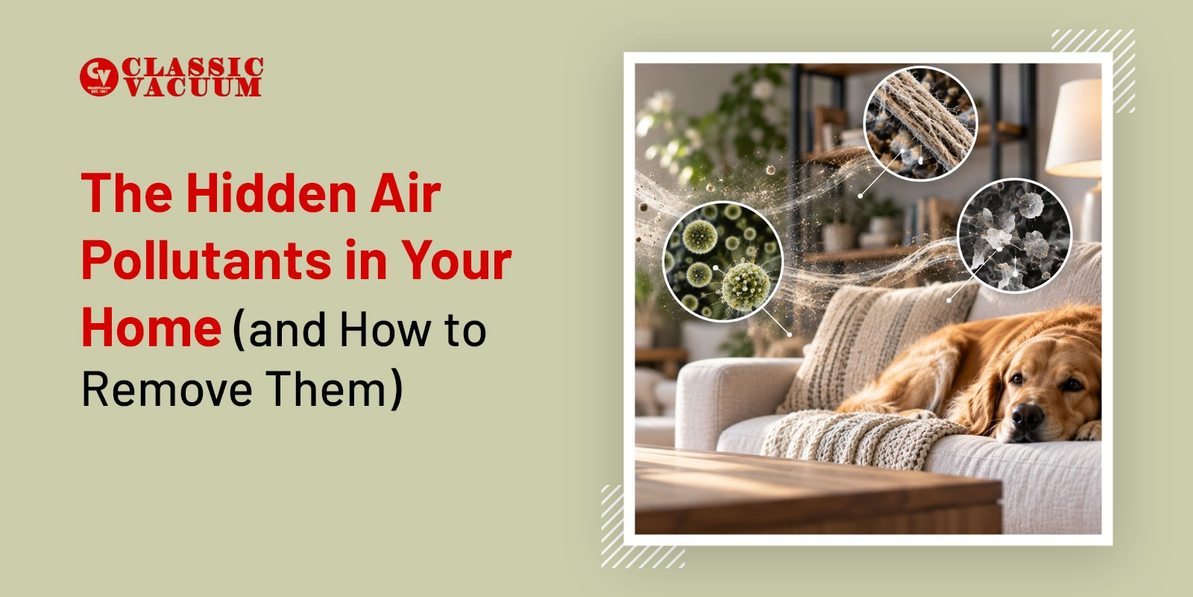
The Hidden Air Pollutants in Your Home (and How to Remove Them)
You can't smell most of what's actually polluting your air. The obvious stuff (cooking smoke, a musty basement, a pet's bedding) is easy to notice and easy to react to. The pollutants that do the most damage over time are usually the ones you never notice at all: invisible gases, microscopic particles, and allergens that build up quietly in the background of everyday life.
Here's what's actually in your home's air, and what it takes to get rid of each type.
The Two Types of Indoor Pollutants
Indoor air pollutants generally fall into two categories, and they require different solutions:
- Particles: Dust, pollen, pet dander, mold spores, and fine particulate matter (PM2.5). These are physical matter suspended in the air, and they're what HEPA filtration is built to capture.
- Gases: Volatile organic compounds (VOCs), formaldehyde, carbon monoxide, and odors. These aren't captured by HEPA media at all; they require activated carbon or chemical-absorbing filtration instead.
A purifier that only handles one of these categories is only solving half the problem. That's why the right unit (and the right filter type) depends on which pollutants you're actually dealing with.
Pollutant-by-Pollutant Breakdown
VOCs and Formaldehyde (New Furniture, Paint, Flooring)
New furniture, fresh paint, carpeting, and composite wood products all off-gas volatile organic compounds. Indoor VOC levels are consistently higher than outdoor levels, sometimes dramatically so, according to the EPA's overview of VOCs and indoor air quality. Standard HEPA filters don't touch these gases at all, you need a purifier with substantial carbon-based media. The Austin Air HealthMate Plus is built specifically for this, with enhanced carbon filtration aimed at formaldehyde, benzene, and similar chemical exposure. This is a good fit for newly renovated homes or anyone dealing with chemical sensitivity.
Pet Dander and Fur
Pet dander is small enough to stay airborne for hours and settle deep into HVAC systems and soft furnishings. It's also one of the most common indoor allergy triggers. For homes with pets, look at the Austin Air Pet Machine filters and models, which pair HEPA capture with a carbon-zeolite layer to handle pet dander and the odors that come with it.
Pollen, Dust Mites, Mold Spores, and General Allergens
These are the classic "allergy season, indoors" triggers, and they don't go away just because you're not outside. Dust mites live in bedding and upholstery, mold spores travel through HVAC ducts, and pollen rides in on clothes and open windows. The Austin Air Allergy Machine uses a military-grade HEGA (High Efficiency Gas Absorption) filter designed to handle this exact combination of particulate and odor-based allergens.
Everyday Dust, Odors, and Smoke
For general household air (everyday dust, cooking odors, and background smoke), the Austin Air HealthMate Standard covers the broadest range of common pollutants and is the right starting point for most homes without a specific chemical or pet-related concern.
Nursery and Baby-Safe Air
Infants breathe faster and spend more time close to the floor, where dust and heavier particles settle. The Baby's Breath Air Purifier is sized and filtered specifically for nurseries and children's rooms.
What Filtration Can't Fix: Source Control and Ventilation
Not every hidden pollutant can be filtered away, and it's important to know the difference.
Radon is a colorless, odorless gas that seeps up from soil and rock through foundation cracks, and it's the second-leading cause of lung cancer after smoking, according to EPA radon guidance. No air purifier addresses radon. The only way to know if it's present is a dedicated radon test, and the fix is a mitigation system (like sub-slab depressurization), not filtration.
Carbon monoxide is another invisible gas, produced by combustion appliances like gas stoves, furnaces, and water heaters. It requires a dedicated CO detector, proper appliance venting, and regular maintenance (not an air purifier).
The lesson here: air purifiers are excellent at handling particles and many VOCs, but source control (fixing the problem at its origin) and ventilation are still the first line of defense for combustion gases and radon.
HEPA vs. Activated Carbon: Why You Often Need Both
HEPA filters trap particles by physically catching them in dense fiber mesh, and they don't do anything to gases or odors. Activated carbon works the opposite way, using a porous surface to adsorb gas molecules, but it doesn't catch physical particles well on its own. That's why every purifier recommended above pairs both technologies rather than relying on just one; a home with pets, new furniture, and everyday dust needs both particle and gas filtration working together, not either/or.
Room-by-Room Hidden Pollutant Checklist
- Kitchen: Cooking-related VOCs, combustion byproducts from gas stoves, grease particulates
- Bedroom: Dust mites in bedding, off-gassing from new mattresses or furniture
- Nursery: Floor-level dust and particulates, fragrance/VOCs from baby products
- Basement/ground floor: Radon (test, don't filter), mold spores from humidity
- Living room: Pet dander, general dust, upholstery-trapped allergens
Signs Your Filter Isn't Keeping Up
A purifier that's been neglected stops protecting you long before it looks obviously dirty. Watch for reduced airflow, a return of odors the unit used to handle, or a filter that's visibly gray or matted. Genuine replacement filters and accessories matter here. Off-brand filters often can't match the carbon density or HEPA rating of the original, which quietly undoes the protection you paid for.
Bringing It All Together
Most indoor air problems aren't the ones you can smell. They're the VOCs off-gassing from last year's new sofa, the dander settled into the carpet, or the radon nobody's tested for. Identifying which category of pollutant you're actually dealing with is the first step; matching it to the right filtration technology is the second.
Explore the full Austin Air Purifier Machines lineup at Classic Vacuum to find the model built for your home's specific hidden pollutants.
Recent Posts
-
SEBO Vacuum Cleaner: The Complete Buying Guide
A good vacuum should make cleaning easier today and still make sense years from now. SEBO has built …16th Sep 2026 -
The Hidden Air Pollutants in Your Home (and How to Remove Them)
You can't smell most of what's actually polluting your air. The obvious stuff (cooking smoke, a must …9th Sep 2026 -

Top Riccar Models for Homes With Dogs and Cats
If you share your home with a dog, a cat, or both, you already know the drill: hair on the couch, da …2nd Sep 2026