
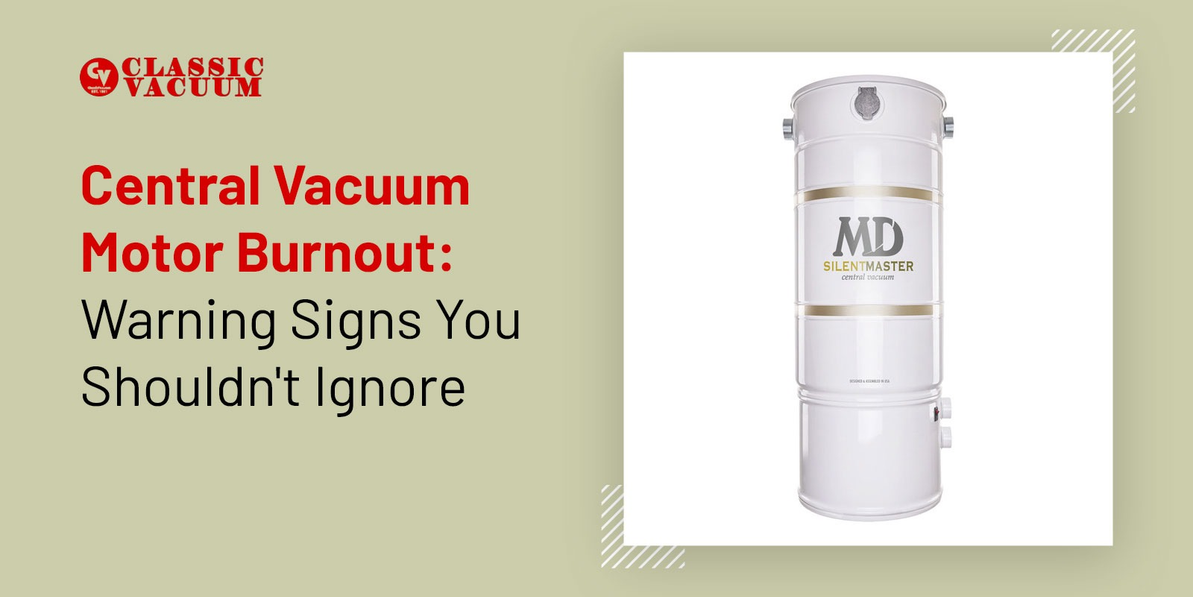
Central Vacuum Motor Burnout: Warning Signs You Shouldn't Ignore
A central vacuum motor is built to run for years without much drama. So when something feels off (a strange smell, a new noise, a housing that's warmer than usual), it's easy to brush it aside as nothing. In our experience at Classic Vacuum, those small warning signs are almost always the system telling you a bigger problem is on the way, and catching it early is usually the difference between a simple repair and a full motor replacement.
If you've already worked through common causes of weak suction and things still don't feel right, motor stress is often the next thing to check. Here's what typically causes burnout, the signs to watch for, and what to do about it.
What Causes Central Vacuum Motor Burnout
Restricted Airflow
This is the number one cause, by a wide margin. A central vacuum motor relies on constant airflow not just for suction, but to cool itself while it runs. A full canister, a dirty filter, or a blocked pipe all force the motor to work harder while getting less of the airflow it needs to stay cool. Run that way long enough, and heat builds up faster than the motor can dissipate it.
Worn Carbon Brushes
Most central vacuum motors use carbon brushes to transfer electrical current to the spinning armature. These brushes wear down gradually over years of use, and as they thin out, the motor has to work harder to maintain consistent power. Worn brushes are a normal part of motor aging, but left unaddressed, they eventually lead to arcing and overheating.
Bearing Failure
The bearings that let the motor shaft spin freely also wear out over time. When a bearing starts to seize or develop excess friction, the motor has to fight that resistance on every rotation, generating heat that has nowhere productive to go.
Exceeding the Duty Cycle
Central vacuum motors are rated for a specific duty cycle, essentially how long they're designed to run continuously before needing a rest. Marathon cleaning sessions, especially in larger homes, can push a motor past that rating, causing heat to accumulate faster than normal.
Electrical Issues or Power Surges
Voltage irregularities, a failing capacitor, or wiring issues in the low-voltage control system can all cause a motor to draw more current than it should, generating excess heat as a side effect.
Warning Signs to Watch For
A Burning or Hot Electrical Smell
This is the single most important sign not to ignore. A burning smell, especially one that resembles hot plastic or ozone, usually means something inside the motor housing is running far hotter than it should.
Grinding, Whining, or High-Pitched Noise
Healthy motors run with a fairly consistent tone. A new grinding or whining sound often points to bearing wear or brush contact problems. Both of these generate heat as a byproduct of the added friction.
A Power Unit Housing That's Hot to the Touch
It's normal for a power unit to feel slightly warm after a long cleaning session. It's not normal for the housing to feel hot enough that you don't want to keep your hand on it.
Suction Weakening Alongside Heat Buildup
When suction drops off at the same time the unit is running hotter than usual, it's a sign the motor is struggling rather than just facing a simple blockage.
The Unit Shutting Off Mid-Use
Many central vacuum motors have a built-in thermal protector that cuts power automatically once internal temperatures cross a safety threshold. If your system keeps shutting off during use, that protector is doing exactly what it's designed to do, and it's telling you the motor is overheating.
What to Do If You Notice These Signs
Stop Using the System Right Away: Continuing to run an overheating motor risks turning a repairable issue into a total motor failure, and a fire hazard in rare cases. The U.S. Fire Administration's guidance on appliance and electrical fire safety is worth a look if you want a general refresher on how seriously to treat an unusual smell or heat from any household appliance.
Check for Airflow Restrictions First: Before assuming the motor itself is failing, empty the canister, check the filter, and inspect the pipe run for blockages. In many cases, this is genuinely all it takes: a motor working against restricted airflow can mimic the symptoms of a failing motor without actually being damaged yet.
Call a Professional if the Signs Persist: If you've cleared any restrictions and the smell, noise, or heat continues, it's time for a proper diagnostic rather than guesswork. At Classic Vacuum, this is the point where we'd recommend booking a service inspection before running the unit again.
Motor Replacement vs. Whole Unit Replacement
Whether it makes sense to replace just the motor or the entire power unit comes down to a few factors: the age of the system, the availability of a compatible replacement motor, and how the repair cost compares to a new unit. On a system that's relatively young and otherwise in good shape, a motor swap is often the more economical choice. On an older unit nearing the end of its typical service life, putting a new motor into an aging housing sometimes doesn't make financial sense compared to replacing the whole power unit. A technician can usually give you a straight answer on which side of that line your system falls on after a quick inspection.
Preventing Motor Burnout
- Empty the canister on a regular schedule rather than letting it fill completely
- Clean or replace the filter according to your system's recommended interval
- Avoid running the vacuum continuously well beyond normal cleaning sessions
- Address weak suction promptly rather than letting the motor compensate for it over time
- Schedule a professional tune-up every year or two to catch brush and bearing wear before it becomes a bigger issue
FAQs
1. What does it mean when my central vacuum smells like burning?
It usually means the motor is running hotter than it should, often due to restricted airflow, worn brushes, or a failing bearing. Stop using the system and investigate before running it again.
2. How long do central vacuum motors typically last?
Most central vacuum motors are built to last 10 years or more with reasonable maintenance, though heavy use and neglected airflow issues can shorten that considerably.
3. Can a clogged filter really cause a motor to burn out?
Yes. Restricted airflow is the leading cause of motor overheating, and a clogged filter is one of the most common sources of that restriction.
4. Why does my central vacuum shut off on its own?
This is typically the motor's built-in thermal protector cutting power because internal temperatures have crossed a safety threshold. This is a sign the motor is overheating, not a random malfunction.
Noticing a burning smell, unusual noise, or a power unit that runs hot? Don't wait for it to get worse. The team at Classic Vacuum can diagnose the issue and let you know exactly what it'll take to fix it. Schedule a service visit today.
Recent Posts
-

SEBO Vacuum Cleaner: The Complete Buying Guide
A good vacuum should make cleaning easier today and still make sense years from now. SEBO has built …16th Sep 2026 -

The Hidden Air Pollutants in Your Home (and How to Remove Them)
You can't smell most of what's actually polluting your air. The obvious stuff (cooking smoke, a must …9th Sep 2026 -

Top Riccar Models for Homes With Dogs and Cats
If you share your home with a dog, a cat, or both, you already know the drill: hair on the couch, da …2nd Sep 2026